Kitchener by Faught C. Brad
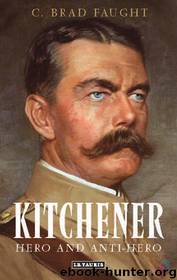
Author:Faught, C. Brad
Language: eng
Format: epub
Tags: Biography, Political leaders and leadership, Modern history to 20th century, Military history, 20th century history, First world war, Colonialism and Imperialism, Warfare and defence, African history, Middle East history, Britain, British Empire
ISBN: 9780857729606
Publisher: I.B. Tauris
8
Egypt Again, 1911–14
Following the King's coronation, Kitchener's leave-taking continued throughout mid-1911, his only official duty at that time being the seat he occupied on the Committee of Imperial Defence. But even this relatively minor assignment had been the focus of a mild contretemps with the government the previous October when Kitchener suspected that his rejection of the Mediterranean Command appointment might have been the reason for his ‘removal’ from the CID. In reply to Kitchener's query, the Prime Minister, H.H. Asquith, was at pains to clarify to him that he had not been removed, but rather that the Mediterranean appointment and the one to the CID were ‘part and parcel of the same offer’ so that when the former was rejected it meant that the seat on the CID automatically went with it. Kitchener, still sore over India, acted a little huffily in this exchange, but in the same letter Asquith now offered him a seat unconditionally, to which he promptly replied: ‘I shall be glad to accept’.1 Upon his return from Africa in time for the coronation he had duly begun to sit on the Council, an ideal vantage point from which to monitor the possibility of other (greater) appointments, especially that of Agent and Consul General in Egypt, the likelihood of which, as we shall see, was now growing.
In the meantime, the renovation of Kitchener's new country home of Broome Park was a constant pre-occupation, but as it was not yet ready for full-time habitation (he did stay over from to time in order to supervise work on it) he spent considerable time at Pandeli Ralli's in London, as well as visiting family and the country estates of various society figures, especially his old favourite, Hatfield House.
These largely domestic and social activities, however, masked the real anticipation Kitchener felt over the prospect of the Egyptian appointment. The current holder of the office was Sir Eldon Gorst, who had succeeded the inimitable Lord Cromer upon his retirement to England in 1907. A career diplomat who had been in Egypt since 1886, Gorst had fulfilled the role of British Agent competently, but the long shadow cast over the job by the singular figure of Cromer was a very difficult one to escape. Moreover, Gorst's health had broken down in 1910 and now, by mid-1911, and suffering acutely from advanced cancer of the pancreas and liver, he had returned to England in anticipation of dying.2 He did so on 12 July and with his sad passing (he was just 50 years old) the Egyptian appointment indeed went to Kitchener.
In the weeks leading up to Gorst's expected death the Foreign Secretary, Sir Edward Grey, had requested Kitchener to come to Whitehall for a meeting, which he did on 19 June. Throughout this period Cromer had been recommending strongly to Grey that Kitchener be given the appointment, and in this the two men's views were consonant.3 Indeed, Cromer's view on this point was the only one that carried much weight with the Foreign Secretary.
Download
This site does not store any files on its server. We only index and link to content provided by other sites. Please contact the content providers to delete copyright contents if any and email us, we'll remove relevant links or contents immediately.
| Anthropology | Archaeology |
| Philosophy | Politics & Government |
| Social Sciences | Sociology |
| Women's Studies |
The Secret History by Donna Tartt(19085)
The Social Justice Warrior Handbook by Lisa De Pasquale(12190)
Thirteen Reasons Why by Jay Asher(8909)
This Is How You Lose Her by Junot Diaz(6885)
Weapons of Math Destruction by Cathy O'Neil(6279)
Zero to One by Peter Thiel(5801)
Beartown by Fredrik Backman(5751)
The Myth of the Strong Leader by Archie Brown(5507)
The Fire Next Time by James Baldwin(5442)
How Democracies Die by Steven Levitsky & Daniel Ziblatt(5218)
Promise Me, Dad by Joe Biden(5153)
Stone's Rules by Roger Stone(5087)
A Higher Loyalty: Truth, Lies, and Leadership by James Comey(4960)
100 Deadly Skills by Clint Emerson(4924)
Rise and Kill First by Ronen Bergman(4788)
Secrecy World by Jake Bernstein(4752)
The David Icke Guide to the Global Conspiracy (and how to end it) by David Icke(4717)
The Farm by Tom Rob Smith(4507)
The Doomsday Machine by Daniel Ellsberg(4490)
